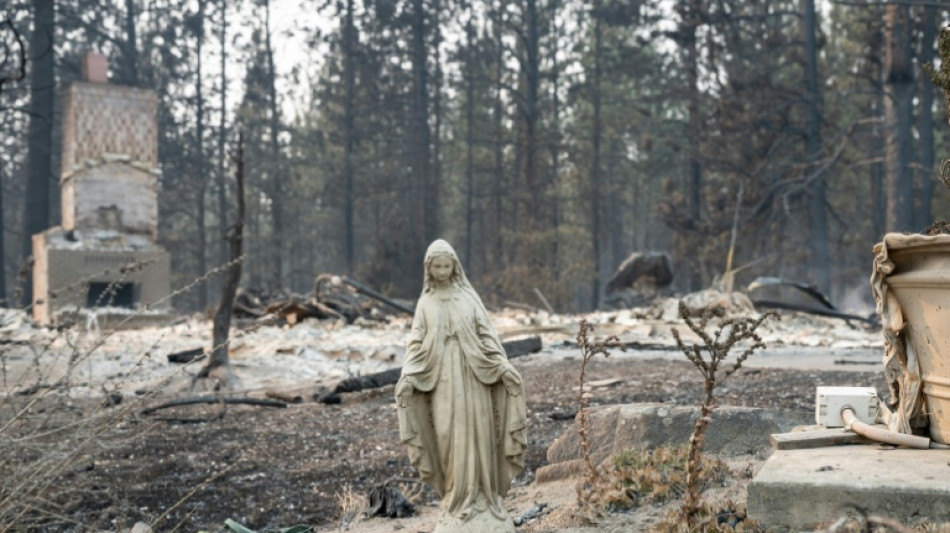
US northwest battles wildfires after Spokane neighborhoods scorched / Photo: © AFP



Wildfires supercharged by drought and intense heat tore through the northwestern US city of Spokane, forcing the evacuation of 65,000 people and reducing hundreds of buildings to cinders, as firefighters raced Monday to contain the flames.
Aerial flybys revealed somewhere between 700-1,110 structures have been lost since the fires broke out over the weekend, authorities said, with anxious families awaiting news about when they could return.
Three fires have combined to burn 8,026 acres (3,248 hectares) in the Spokane area of Washington state according to InciWeb, a federal interagency information system, with firefighters making use of cooler temperatures, higher humidities and thick smoke to make "significant gains" against two of them.
Local officials said so far no one has been reported hurt.
Cooler temperatures were expected Monday and Tuesday, though the respite will be brief, with a warming trend resuming mid-week that will raise temperatures into the mid to high-90's Fahrenheit (mid-30s Celsius) with relative humidity in the lower teens.
Video of the fire aftermath on Sunday showed scores of homes burned to the ground, with only their brick fireplaces and foundations remaining, while other houses nearby escaped practically unscathed.
"Just driving around looking at the homes -- it's just one of the most heartbreaking things I've ever seen in my life," Spokane resident Geoff Beadles told AFP, after evacuating with his fiancee and two dogs.
- More frequent fires -
Authorities are attempting to make contact with 14 people whom they have failed to reach by cell phone but are not yet presumed missing, Sheriff John Nowels told a press conference Monday.
"I think the estimate is potentially up to 65,000 people we had to move out of these areas, and if you think about what that entails, the fact that we were able to get people out of those areas within several hours in an active fire zone is pretty incredible," said Nowels.
Mayor Lisa Brown said authorities were combing the city block by block to assess damages and potential reignition, and couldn't tell people yet when they could return home.
"It could be weeks, depending on where your home and property is," she said.
"I think from a historical standpoint, this is likely the worst natural disaster in Spokane's history," Washington Governor Bob Ferguson added.
Ferguson, who has been speaking with President Donald Trump, said he was awaiting the approval from the federal government of assistance including for search and rescue, debris removal, medical supplies and assistance, temporary sheltering and emergency power.
"I'm very optimistic that they will grant it, and hopefully very soon," he added.
Ferguson declared a state of emergency on August 1, citing drought conditions that have stretched four consecutive years, unusually high temperatures and high winds exacerbating record-setting wildfires.
Human-caused climate change is increasingly creating conditions for more frequent and intense wildfires, through increased heat, extended drought, and a "thirsty" atmosphere that enhances the drying of organic matter.
It is a vicious loop, with increased wildfires releasing massive amounts of carbon dioxide into the atmosphere, accelerating planetary warming.
- 'Extraordinary wildfire season' -
Fire officials warned that "unauthorized" drone incursions into restricted airspace above wildfires were forcing the grounding of helicopters and other aircraft fighting the blazes.
The head of Washington's Department of Natural Resources, David Upthegrove, said the fires in Spokane were among 16 major blazes burning throughout the state of Washington, covering 262,000 acres.
"This is an extraordinary fire season," he said.
An outage map published by local utility Avista showed over 6,445 customers were without power due to the fires as of early Monday.
The biggest of the three fires burning in Spokane, the Old Trails fire, jumped the Spokane River on Saturday afternoon and crossed into the city proper.
Another resident, Tena Risley, said she saw flames behind trees near her home and, in a panic, she grabbed her dog and a few things. She got stuck in traffic trying to flee as the fast-moving fires blocked routes out of the city.
"There were probably hundreds and hundreds of cars," she told AFP.
K.Parker--VC