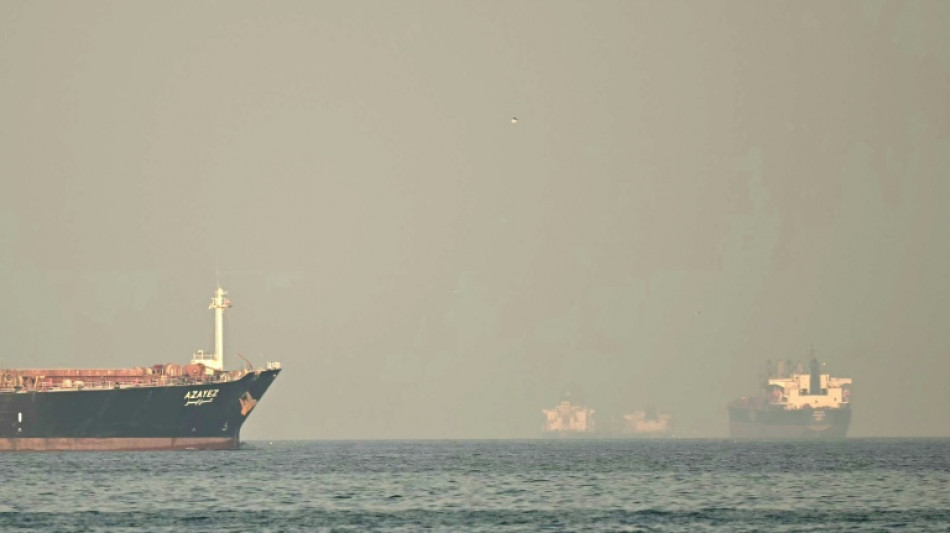
Ships brandish China-links to weave through Strait of Hormuz / Photo: © AFP/File




Ships anchored in the Gulf or transiting the Strait of Hormuz are changing their tracking data to boast links to China in an attempt to evade Iranian attacks, according to data from shipping tracker Marine Traffic analysed by AFP.
Iran has effectively closed the vital waterway since US-Israeli strikes on it began on February 28, and at least 10 vessels have been attacked since.
But by claiming to have an "all-Chinese crew" aboard, or changing their destination to "Chinese owner", vessels are linking themselves to Iran's most important economic partner, Beijing.
"These appear to be precautionary signals used by ships attempting to reduce the risk of being targeted," according to Ana Subasic, trade risk analyst at Kpler, which owns Marine Traffic.
That "does not always signal direct Chinese ownership," she told AFP.
On Monday, Panama-flagged cargo ship Guan Yuan Fu Xing was the latest to make it safely through the Strait of Hormuz, two days after changing its destination to "CHINA OWNER" via its AIS transponder.
Similar to plane signals, the AIS safety system allows vessels to broadcast their details, positions and destination to ports and other vessels. These signals are collected by trackers including Marine Traffic.
In the past week, around 30 other ships in the Gulf or transiting the Strait of Hormuz have pulled similar manoeuvres -- some more audaciously than others.
- 'Muslim vessel' -
The Iron Maiden, registered in the Marshall Islands, and the Liberia-flagged Sino Ocean, brandished China links while sailing through the strait, then removed them once they were out.
Others broadcast similar messages, sometimes for only a few minutes, while stationary.
At least two ships have broadcast signals indicating Turkish ownership and crew members, or in one case the day the war broke out, declaring itself "Muslim".
Since last Monday, more than 20 commercial vessels have been detected crossing the strait, according to AFP analysis of Marine Traffic data.
Others have gone through the Strait of Hormuz with their transponders switched off to conceal their position, sometimes only reappearing on marine trackers once safely out of the area.
Of the ships that transmitted at least one signal while attempting the passage, AFP counted nine oil tankers and two liquefied natural gas (LNG) tankers.
Before the war, a daily average of 138 ships transited the Strait of Hormuz, which carries a quarter of the world's seaborne oil and a fifth of all LNG.
Its effective blockade has caused oil prices to soar past $100 a barrel for the first time since Russia's invasion of Ukraine in 2022 -- fulfilling what experts said was Tehran's goal.
By "jacking up insurance premiums and global energy prices," Iran could "put pressure on the US" as well as its oil-rich Gulf allies, Ali Vaez, Iran project director at International Crisis Group, told AFP.
French President Emmanuel Macron on Monday said France and its allies are preparing a "purely defensive" mission to escort ships and reopen the strait.
Iran has said the waterway is not officially closed, but its security chief Ali Larijani warned again on Monday that the waterway would not be safe as long as war continues.
V.Gonzalez--VC