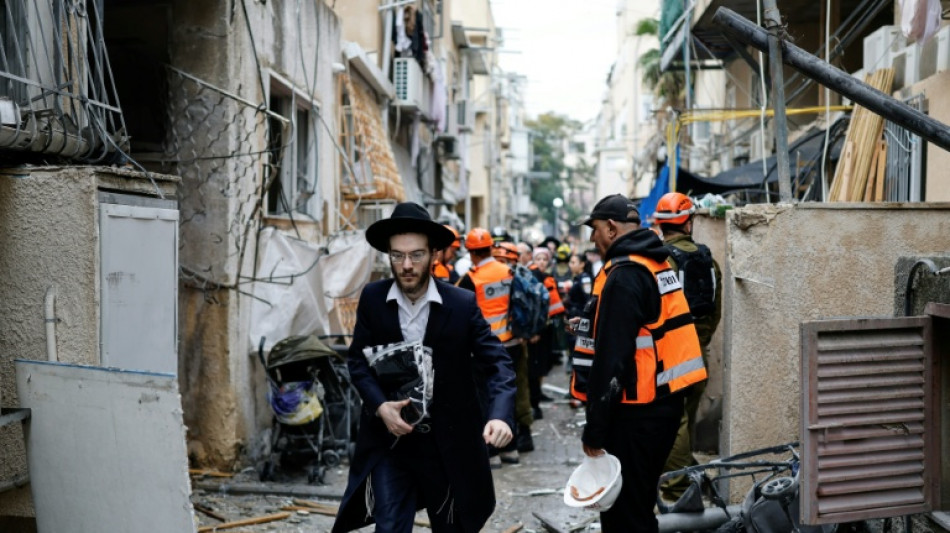
Trump says Iran asks for ceasefire as Tehran hit by fresh strikes / Photo: © AFP



President Donald Trump said Wednesday that Iran had asked for a ceasefire, but ruled out any truce until the vital Strait of Hormuz was reopened for crucial energy shipments.
The White House said the president would make "an important" national address at 9:00 pm (0100 GMT Thursday) -- his first prime-time speech since the conflict began -- after he earlier said the war could be over in "two weeks, maybe three".
Tehran has insisted there are no ongoing negotiations, and launched fresh missile strikes on Israel and US-allied Gulf nations on Wednesday, as AFP journalists reported massive explosions in the Iranian capital.
Trump's statements have see-sawed between combative and conciliatory since US-Israeli strikes on February 28 sparked the regional war and a global energy crisis after Iran choked off shipping through the narrow Strait of Hormuz.
Iranian President Masoud Pezeshkian had said the Islamic republic had the "necessary will" for a ceasefire, but only if its foes guaranteed that hostilities would not return.
In a post on his Truth Social platform, Trump said Pezeshkian "has just asked the United States of America for a CEASEFIRE!"
"We will consider when Hormuz Strait is open, free, and clear. Until then, we are blasting Iran into oblivion or, as they say, back to the Stone Ages!!!"
Iran's Revolutionary Guards said Wednesday that the strait, through which one-fifth of the world's oil normally passes, would remain closed to the country's "enemies".
The Guards also confirmed they hit an oil tanker in the Gulf they said belonged to Israel. A British maritime security agency said the vessel was struck off Qatar, reporting damage but no casualties.
- 'Every day we hear drones' -
An AFP journalist reported huge explosions in Tehran on Wednesday afternoon and earlier strikes near the former US embassy, now a symbol of decades of US-Iranian tensions.
Iranian media also said steel complexes in central and southwest Iran were hit, causing "significant damage and destruction".
The Israeli military confirmed it struck Tehran, while emergency services in Israel said an Iranian missile attack wounded 14 people, including an 11-year-old girl.
Israel also said its air defences had responded to a missile fired from Yemen -- the third attack by the Iran-backed Houthi rebels since they entered the war over the weekend.
In Lebanon, seven people were killed in strikes around south Beirut, the health ministry said Wednesday, with the Israeli military saying it had struck a senior Hezbollah commander.
A Lebanese security source and a Hezbollah source both told AFP that the strike had killed Hezbollah's top commander for Iraq military affairs.
AFP correspondents at the scene saw a blackened, debris-strewn street.
"Nobody knows what's happening," resident Hassan Jalwan told AFP, adding that "displaced people have been sleeping in the open" in the area.
Israel launched broad strikes and a ground offensive against Lebanon after attacks on March 2 by the Tehran-backed militant group Hezbollah.
The Lebanese health ministry said Wednesday that Israeli attacks had killed more than 1,300, among the thousands reported killed across the region since the war began, mostly in Iran.
Iran has also carried out retaliatory attacks on nations in the Gulf it says have been launchpads for strikes.
A Bangladeshi national was killed on Wednesday by falling shrapnel from an intercepted drone in the United Arab Emirates.
Strikes in Kuwait caused a large fire in fuel tanks at its international airport, Bahrain's interior ministry said a fire broke out at a business facility, and Saudi Arabia said several drones were intercepted.
Meanwhile, a drone strike caused a massive fire at the storage facilities of an engine oil firm in Iraq's autonomous Kurdistan.
"Every day, we hear the sound of drones," Waad Abdulrazaq, a 31-year-old truck driver, told AFP near Iraq's Erbil international airport.
"We hear them in the morning, and we hear them at night. We can no longer sleep or live in peace."
- Energy crisis -
Optimism sparked by Trump's comments on the timeline for the end of the war pushed oil prices down Wednesday, and stock markets rallied in Europe and Asia.
But Iran's chokehold on critical oil and gas shipments through the Hormuz has sent energy prices soaring and unleashed global economic turmoil.
Average US gasoline prices topped $4 a gallon for the first time in four years this week, while European inflation spiked and governments around the world started to unveil support measures.
"We're a small outfit," driver Nicolas Barthes told AFP at a protest against soaring fuel prices in the French city of Toulouse. "The additional diesel cost for me this month is €15,000, and we're not managing to pass all of that on."
Susannah Streeter, chief investment strategist at Wealth Club, said prices were still about 50 percent above pre-war levels, showing "scepticism still remains about Trump's claims of progress".
Trump has criticised allies for not helping in the war, and President Emmanuel Macron repeated Wednesday that France would not take part.
Britain said Wednesday that it would host a meeting of about 35 countries this week to discuss how to reopen the strait.
Washington has not said who it is speaking with in Iran, which has denied it is in talks.
Iranian Foreign Minister Abbas Araghchi told Al Jazeera he still receives messages from US envoy Steve Witkoff, "directly, as before, and this does not mean that we are in negotiations".
Trump threatened earlier this week to "obliterate" Iran's oil wells, its main Kharg Island export terminal, and possibly water desalination plants if the Islamic republic didn't make a deal.
burs-np/smw
A.Allen--VC