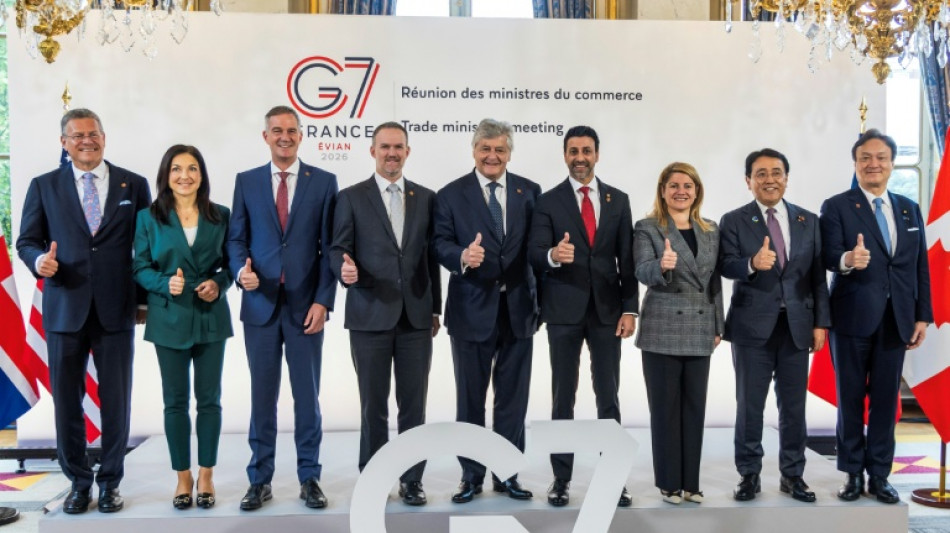
G7 decries 'economic coercion' in swipe at China / Photo: © POOL/AFP



The trade ministers of the Group of Seven leading industrialised nations Wednesday criticised "economic coercion" by powers placing arbitrary restrictions on exports, particularly critical minerals, in a clear swipe at China.
While never mentioning China by name, the ministers clearly took aim at Beijing and its stringent export controls on rare earths in their statement, after two days of meetings in France.
"We express our grave concerns regarding economic coercion, including coercion through arbitrary export restrictions that may lead to supply chain disruptions, notably for critical minerals, and undermine economic security and resilience," the ministers said.
China dominates the global industry for rare earths, which are critical for making a wide range of products -- from everyday consumer electronics to equipment used in the defence sector.
The country's leaders leveraged that strength in spectacular fashion last year, reaching a deal with Washington in October to pause a blistering trade war after Beijing's curbs on their exports sent shockwaves across supply chains.
Despite resuming exports, the approvals process has been causing headaches for many foreign firms seeking to move supplies and products abroad.
The G7 ministers vowed to work with partners to not only reduce their dependency upon rare earths, but to "ensure that attempts or threats to weaponize economic dependencies will fail.
"We seek to deter and stand ready to take actions, where necessary, against economic coercion," they added.
Supply of rare earths is expected to be a key discussion point at the summit between US President Donald Trump and his Chinese counterpart Xi Jinping in Beijing next week.
China has repeatedly used export controls as well halting imports to put pressure on trading partners.
The trade ministers of the Group of Seven nations -- Britain, Canada, France, Germany, Italy, Japan and the United States -- gathered as part of preparations for a summit next month in the eastern French city of Evian along the shore of Lake Geneva.
They also spoke out against "pervasive, opaque and harmful industrial subsidies, market-distortive practices of state-owned enterprises, and all forms of forced technology transfer".
China's subsidising of certain sectors such as steel, solar panels, wind turbines and electric vehicles has created trade tensions for years.
- Small parcels, big challenge -
The ministers also discussed the rapid growth of cross-border trade driven by e-commerce sites "which raises increasing challenges".
This has generated huge volumes of small parcels that they say escape customs duties and pose unfair competition to local retailers.
The US last year suspended the tariff exemption on small parcels valued at less than $800 and the EU will this summer put in place a flat-rate customs duty on packages valued at under 150 euros.
While emphasising the importance of engaging private sector shareholders, the ministers called for strengthening cooperation to promote fair competition and ensure product safety.
The ministers also touched on the failure in March of the latest round of World Trade Organization negotiations, with the body's role as a trade referee having been paralyzed by the United States for years.
"We acknowledge the agreed upon rules in the WTO are key to facilitating global trade," the ministers said.
However, they also underlined "the valuable role plurilateral initiatives can play in advancing progress on issues relevant to members".
The WTO's forerunner was responsible for negotiating the global agreements that reduced tariffs on trade in goods that helped bring about post-WWII prosperity.
However, WTO members have had difficulty in expanding trade agreements, with regional free trade deals having become the main driver of boosting trade in recent decades.
C.Campbell--VC