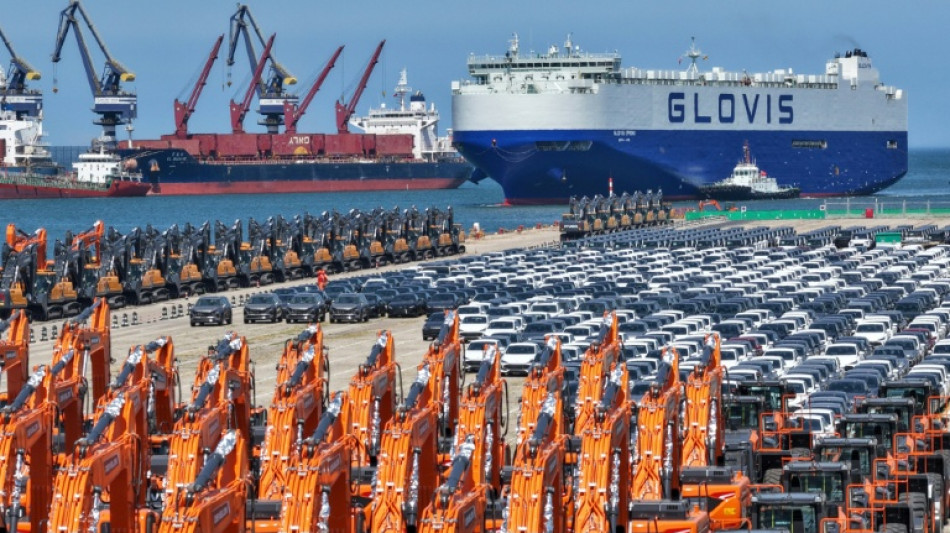
China exports surge as Beijing withstands Middle East stress / Photo: © CN-STR/AFP




Chinese exports surged by almost a fifth last month, official data showed Tuesday, as shipments of tech components and machinery helped the world's second-largest economy weather pressure from the Middle East war.
The spike marks a bright spot for the Chinese leadership as it struggles to kickstart growth following the pandemic and amid trade frictions with the United States.
The 19.4 percent year-on-year jump in overseas shipments was driven largely by artificial intelligence and auto exports, the General Administration of Customs (GAC) said, and topped the 15.0 percent forecast in a Bloomberg survey of economists.
It was also faster than April's 14.1 percent jump.
Imports soared 27.4 percent year-on-year in May, topping the 26.0 percent estimated in the Bloomberg survey. That will come as some comfort to Beijing as it looks to shift the country's drivers of growth away from manufacturing and towards domestic consumption.
Exports to the United States surged 35.4 percent on-year, as Donald Trump visited Beijing with trade high on the agenda. The surge also came from a low base of comparison after the US president sparked a trade war with Beijing in April last year.
Shipments to the world's biggest economy hit $39 billion, according to the GAC, up from $28.8 billion 12 months ago.
"The strong export growth shows the competitiveness of the Chinese firms in the international market," said Zhiwei Zhang of Pinpoint Asset Management.
"It helps to offset some of the weakness in the domestic demand."
But, Zhang warned, there was still a risk of "potential escalation of trade tension between China and the major trading partners such as Europe".
The European Union said last month it needed to act more forcefully to rebalance its trade relationship with China.
Talks held among European commissioners on protecting critical industries from Chinese rivals will feed further discussions at the G7 heads of state meeting in France and an EU leaders' summit in Brussels this month.
Last month, China kept a trade surplus of $105 billion, from $85 billion in April, a gap that is worrying for European economies and other governments.
Experts are increasingly warning of a "China shock 2.0", with a glut of inexpensive goods made in the Asian powerhouse threatening manufacturers around the world as trade deficits widen.
Despite surging trade, weaker demand and rising energy costs caused by the Middle East war have started to weigh on economic growth.
China's factory activity was flat last month after two months of expansion, official data showed.
The country's factories are facing higher costs with the prices of raw materials rising, particularly in the energy and chemical sectors, as shipping constraints remain a problem.
G.Thomas--VC