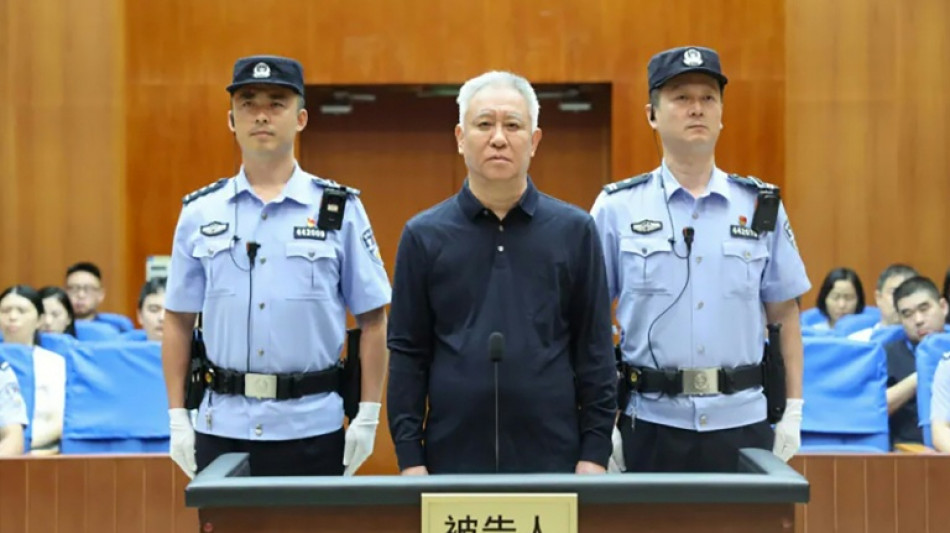
Evergrande's Xu Jiayin: from real-estate tycoon to life in prison / Photo: © Shenzhen Intermediate People's Court/AFP




Once China's richest man, disgraced property tycoon Xu Jiayin looked worn as a court in China handed the now white-haired Evergrande founder a life sentence on Thursday.
The 67-year-old, known as Hui Ka Yan in Cantonese, was convicted of a list of crimes including fraud, bribery and embezzlement relating to his leadership of Evergrande Group, the country's biggest real estate conglomerate before it defaulted in 2021.
Xu's rags-to-riches ascent mirrored the country's economic rise.
And his fall comes as China is still struggling to recover from a housing slump triggered by Evergrande's collapse.
- Rural roots -
Xu was born into a poor family in rural Henan province in 1958, the year leader Mao Zedong launched his "Great Leap Forward" -- an industrialisation plan that led to mass starvation.
Xu, whose mother died when he was a year old, recalled in a speech how he ate only sweet potato and steamed bread in his school years.
"The sheets I laid, the quilts I covered, and the clothes I wore were all covered with piles of patches," said Xu.
"At that time, my greatest wish was to go out of the countryside, find a job and be able to eat better food."
After leaving school in 1976 -- the end of the decade-long Cultural Revolution -- he struggled to find work.
- Glamorous rise -
As colleges reopened, Xu studied metallurgy and was later assigned to a state-run steel factory.
He left in 1992 for Shenzhen, the buzzing heart of China's reform and opening-up experiment in the 1990s.
He ended up working in real estate, and in 1996 founded Evergrande, which threw itself into mass development, building in-demand apartments across China and capitalising on its rapid wealth accumulation.
The group listed in Hong Kong in 2009, raising $729 million in its initial public offering, at the time making it China's largest private real-estate company and Xu the mainland's richest man.
- Football and fashion -
In 2010, Xu bought the struggling Guangzhou football team, renaming it Guangzhou Evergrande and pouring money into world-class players and coaches.
A football novice when he bought the club, Xu helped the team win multiple league championships.
He also became known for a love of luxury labels, particularly French brand Hermes -- earning him the nickname "Belt Xu" after being spotted wearing a Hermes belt to the national political congress.
Some speculated his success came from useful close relationships, including with the brother of former premier Wen Jiabao.
But Xu attributed his success to education -- and the Communist Party.
"Everything of Evergrande is given by the Party, the state and the society," he said.
Over the years, however, Xu's taste for yachts and luxury clashed with President Xi Jinping's crackdown on extreme wealth as Beijing tightened its watch over corruption within the financial sector.
- Property bust -
The tide turned in 2020, when regulations from Beijing seeking to limit excessive borrowing in the real-estate sector complicated Evergrande's ability to make payments.
It started to falter under the new "three red lines" -- caps for three different debt ratios -- which forced the group to offload properties at increasingly steep discounts.
Evergrande struggled to appease angry homebuyers and investors, as the firm's crisis triggered rare protests outside its offices in China.
Seeking to reassure his employees in September 2021, Xu told staff in a letter he believed the group would "step out of the darkest moment soon".
A month later, Chinese authorities reportedly told Xu to use his personal wealth to alleviate his firm's debt crisis.
That December, Fitch Ratings agency declared the firm in default.
- Downfall -
Two years later, media reported that Xu was being held by police.
The next day, Evergrande said in a filing to the Hong Kong Stock Exchange that Xu had been suspected of "illegal crimes", without giving details.
There were no reports of Xu being seen in public for nearly three years, including when Evergrande was delisted from the stock exchange in 2025.
By 2023, Xu's wealth was estimated at $1.8 billion -- down from $42 billion in 2017 -- according to the Bloomberg Billionaires Index.
In April 2026, a court in Shenzhen said Xu had pleaded guilty and "expressed remorse" for crimes including fraud, embezzlement and bribery.
On Thursday, the court sentenced him to life in prison and fined Evergrande Group and an affiliate more than $2 billion.
This time, the court did not mention if Xu spoke.
R.Clark--VC