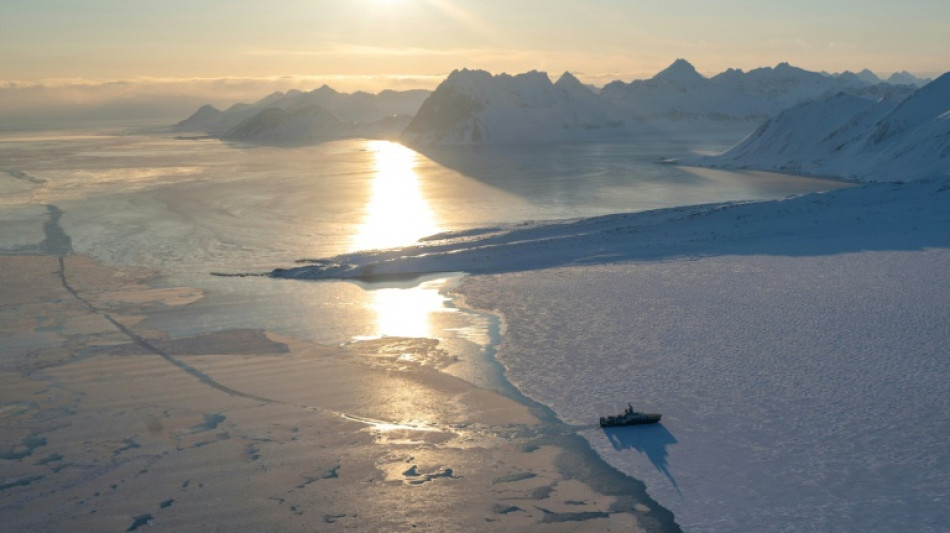
Arctic sea ice at lowest level ever this winter / Photo: © AFP




Arctic sea ice reached its lowest level ever recorded, statistically tying last year's record, a leading US climate observatory for this geopolitically significant region said on Thursday.
The ice is formed by seawater that freezes through the winter. It partially melts through the summer. However, the amount of reformation each winter is in decline, as rising temperatures due to climate change disproportionately affect the Arctic.
- Earlier and lower levels -
This year's maximum ice level was reached on March 15 -- a week earlier than last year.
The ice clocked in just below last year's level at 14.29 million square kilometers, a statistical tie with last year's all-time record low of 14.31 million square kilometers, according to the National Snow and Ice Data Center (NSIDC) in Boulder, Colorado.
It is the lowest level observed in 48 years of satellite monitoring. Previous records were set in 2016, 2017, and 2018.
This year's weak ice formation "gives a head start to the spring and summer melt season," said NSIDC Senior Researcher Walt Meier.
Samantha Burgess of the European Centre for Medium-Range Weather Forecasts (ECMWF) had a similar analysis in a recent conversation with AFP, saying it may trigger a "potentially faster and more extensive summer melt."
The weak ice growth was visible on satellite for weeks, as AFP reported earlier in March.
- Impacts on wildlife, geopolitics -
Unlike land-based ice -- such as glaciers or ice sheets -- melting sea ice does not directly raise sea levels. But it does cause wide-ranging climate impacts that threaten ecosystems.
Many species, including polar bears in the Arctic and emperor penguins in Antarctica, rely on sea ice to breed and feed.
Some effects can cascade.
"There are areas, for example, in the Beaufort Sea, near Canada or the Siberian seas of the ocean, that had never been exposed to the atmosphere," says Gilles Garric, a polar oceanographer at Mercator Ocean Toulouse. That exposure, in turn, could make these waters warmer in the summer.
The melt also has geopolitical consequences, as it opens new shipping routes and access to mineral resources. Since returning to the White House, Donald Trump has repeatedly said he wants to take over Greenland.
"From a geopolitical perspective, the climate change-induced melting of sea ice is turning the Arctic into the new Mediterranean: a common shared maritime resource surrounded by competing states," Elizabeth Chalecki, an expert on climate change and security, told AFP.
B.Johnson--VC