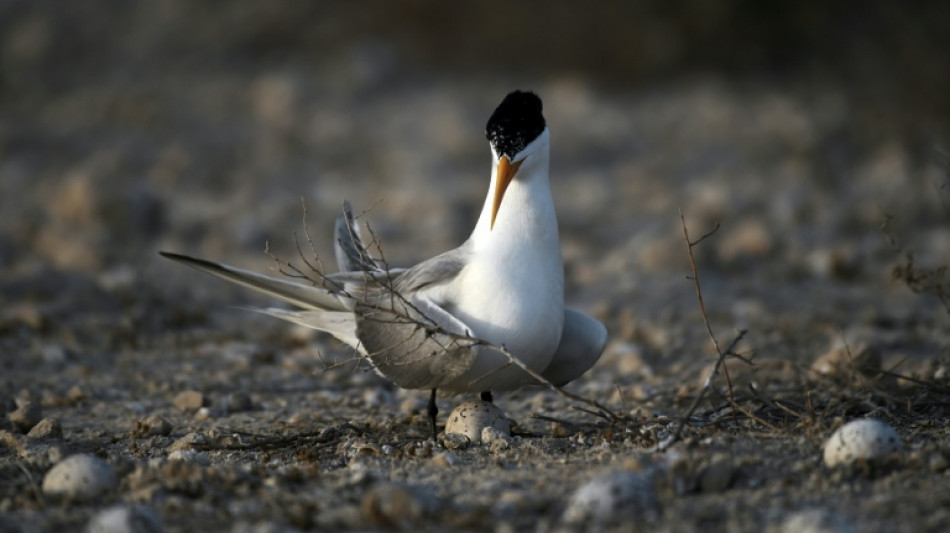
H5 bird flu detected in Australian seabird for first time / Photo: © AFP/File




Scientists have detected the highly contagious H5 bird flu in an Australian seabird for the first time, the government said Friday.
Australia was for years the only continental landmass to be free of the H5 strain, which has caused severe disease and high death rates in poultry and wild birds worldwide.
A total of 12 cases of H5 bird flu have been confirmed in Australia since June but all of them were in migratory sea birds, not local wildlife.
Laboratory testing confirmed the disease had infected a greater crested tern in the town of Robe, South Australia.
"While this, of course, is a concerning development it is not unexpected," Agriculture Minister Julie Collins said.
"I do want to reiterate, though that at this time there is still no evidence of any mass mortality due to the H5 bird flu," she told a news conference in Hobart, capital of the island state of Tasmania.
There was no sign the virus had spread to other animal populations, poultry or agriculture systems, "and there remains a low risk to human health", the minister said.
Scientists were seeking to establish the potential pathways for the virus's spread to the Australian bird, Collins added.
- 'Enhanced surveillance' -
"What we do know is that this is a coastal seabird that has an overlapping coastal range with migratory sea birds that have previously tested positive for H5."
The South Australian state government had implemented "enhanced surveillance" in the area where the bird was found, she said.
There has been concern that the deadly disease could add to the extinction risks faced by Australian fauna, many of which are unique to the vast continent.
Almost half of Australia's wild bird species, and 83 percent of its mammals, are found nowhere else.
The wild birds most affected by the H5 strain include waterfowl, shorebirds, seabirds and birds of prey.
Marine mammals have also been affected, with some detections in other animals such as cats, goats, alpacas and pigs.
Officials have previously said they are investigating if the disease arrived in Australia via birds migrating from the sub-Antarctic.
Scientists said in June the H5 bird flu strain had killed more than 13,000 elephant seal pups after infecting a breeding colony on the remote Heard and McDonald Islands, one of Australia's external territories in the sub-Antarctic.
V.Gonzalez--VC