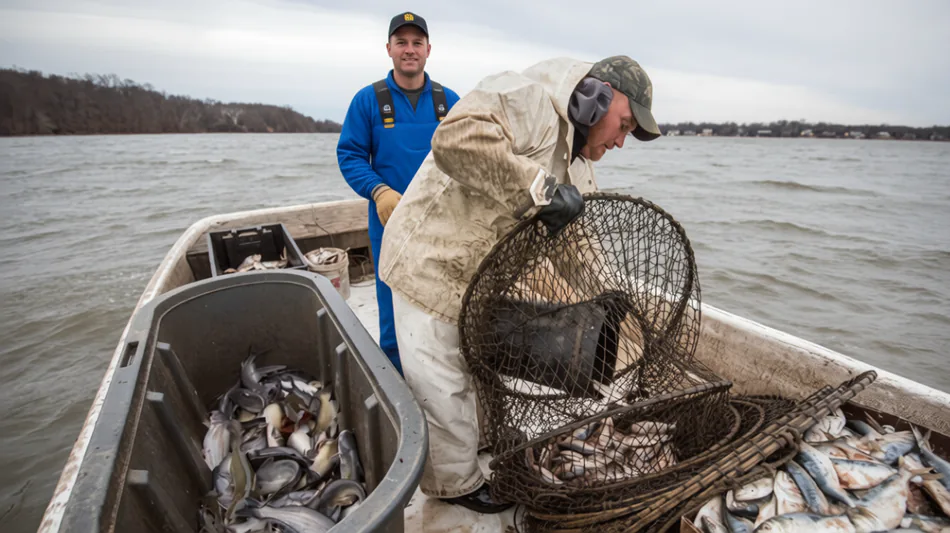
Fisheries Commission Lowers Chesapeake Bay Menhaden Cap Amid Conservation Concerns



The Atlantic States Marine Fisheries Commission voted this week to reduce the industrial catch limit for menhaden in the Chesapeake Bay by 27 percent starting in 2027. While the decision marks a step toward ecological balance, conservation advocates warn that the new caps fall short of scientific recommendations needed to sustain predator populations like ospreys and striped bass.
The Atlantic States Marine Fisheries Commission has agreed to lower the industrial catch cap for menhaden in the Chesapeake Bay, but the decision has drawn sharp criticism from conservationists who argue the reductions are insufficient to protect the region’s ecological balance.
At its annual meeting held from November 9 to 12 in Newport, Rhode Island, the commission’s Menhaden Management Board approved a coastwide catch limit reduction of approximately 9 percent for 2027 and another 9 percent for 2028. Within the Chesapeake Bay specifically, the cap on reduction fishing—the process of converting fish into meal and oil—will drop by 27 percent in 2027 and by 34 percent in 2028.
The multibillion-dollar aquaculture industry relies heavily on menhaden, small oily fish that filter plankton and serve as a critical food source for coastal predators such as striped bass, bluefish, and ospreys. The Chesapeake Bay serves as a vital nursery for the species, making its management a focal point of debate between commercial interests and environmental advocates.
Under the new regulations, the total allowable catch for the commercial fishery stretching from Maine to Florida will decrease from 186,840 metric tons this year to 170,000 metric tons in 2027, and further to 155,000 metric tons in 2028. This follows a 20 percent reduction implemented in 2026.
The commission stated that it weighed the ecological benefits of leaving more menhaden in the water against the economic impact on harvesters and fisheries that depend on the fish for bait. However, the commission’s own technical committee projected that a 39 percent cut, reducing the catch to 114,200 metric tons in 2027, would provide managers with a 50 percent chance of meeting the ecological fishing target.
That target is designed to maintain healthy levels of striped bass but does not account for the needs of ospreys or measure the specific abundance of menhaden within the Bay. The commission acknowledged that the adopted limits will likely allow more fishing than the ecological target requires, but maintained that they do not pose a risk of overfishing as defined by a looser regulatory threshold.
Actual catch volumes remain a point of contention. A fishery review indicates that last year’s commercial catch was just under 147,000 metric tons, which is below both the new adopted limits. Consequently, the 2027 coastwide limit leaves room for approximately 50 million pounds more than the industry caught in the previous year.
In the Chesapeake Bay, the board tied the reduction fishery’s cap to 21.8 percent of the coastwide limit. This lowers the cap from 51,000 metric tons to 37,123 metric tons in 2027 and to 33,847 metric tons in 2028. The board established that the Bay cap cannot exceed 51,000 metric tons even if the coastwide limit rises, and it decided to revisit the cap at least every three years. These regulations apply specifically to reduction fishing and do not cover the bait fishery, which catches menhaden for recreational and commercial use.
The new coastwide limit takes effect on January 1, 2027, while the Bay-specific cap begins on May 1.
Conservation groups expressed disappointment that the board did not adopt seasonal quota periods. Supporters argued that such quotas would spread the harvest across the fishing season, easing pressure on menhaden populations during the critical summer months when ospreys are feeding their chicks. The debate over redistributing the coastwide quota among states was postponed until January.
Virginia holds approximately 75 percent of the coastwide quota and is home to the Atlantic coast’s only active menhaden processing plant. According to the nonprofit Theodore Roosevelt Conservation Partnership, Maryland, North Carolina, Florida, Connecticut, Massachusetts, Rhode Island, and New York voted in favor of deeper coastwide cuts but were outvoted.
In the Bay, the majority of menhaden fishing is conducted by Ocean Harvesters, which supplies Omega Protein’s processing plant in Reedville, Virginia. A spokesperson for Ocean Harvesters stated that the company was disappointed with the cuts and warned that the consequences would be felt by fishermen, processing workers, and dependent businesses.
“The commission should have allowed the newly funded research to proceed before imposing additional restrictions,” the spokesperson said in an email. The company questioned whether the new restrictions would produce the claimed benefits but affirmed its support for ongoing research and its commitment to a sustainable fishery.
The commission’s latest assessment, based on data through 2023, found that menhaden are not overfished along the coast. However, it acknowledged a lack of data regarding the specific number of menhaden in the Bay and how fishing affects that population.
Chris Moore, executive director of the Chesapeake Bay Foundation’s Virginia office, pointed to falling catches in Maryland, Potomac River, and Virginia waters as evidence of low menhaden availability. He noted that menhaden caught in the Bay are now younger and lighter than in the past, indicating a population under stress.
Jaclyn Lunaas, forage fish program manager for the Theodore Roosevelt Conservation Partnership, criticized the commission for failing to manage menhaden according to its own ecosystem-based science. Allison Colden, the Chesapeake Bay Foundation’s Maryland executive director and a board member, also criticized the rejection of seasonal quotas.
“Reducing the Bay cap overall is a significant win and a step in the right direction,” Colden said. “But it still leaves the door wide open for the industry to catch everything in the three-week time period in the summertime when both our fisheries and our predators really need it.”
Virginia has approved $2 million over two years for menhaden research to inform a scientifically tested harvest cap. Moore stated that his foundation will continue to press Virginia lawmakers to place observers on fishing vessels. Earlier this year, Congress approved $2.5 million for Bay-specific research that could inform future management decisions.
D.Wilson--VC