Iranian state TV's broadcast of women without hijab angers critics / Photo: © AFP
The broadcast by Iranian state-controlled television of interviews with several women not wearing the Muslim headscarf during a rally commemorating the Islamic revolution has angered critics of the clerical system who accused authorities of hypocrisy.
Since shortly after the 1979 revolution, it has been obligatory for women to cover their heads in public, although in recent months there has been growing evidence of women openly flouting the rule, especially in the capital Tehran.
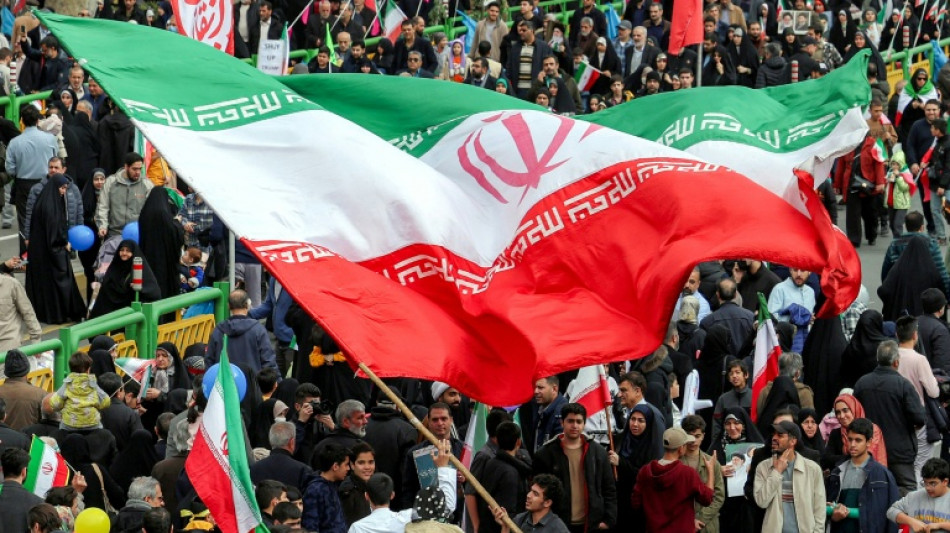
At the annual nationwide rallies on Wednesday marking the anniversary of the revolution, state television for the first time showed women taking part who proclaimed their support for the authorities but were bareheaded.
Critics accused authorities of a cynical move after the Islamic republic was shaken by protests last month that were suppressed by a crackdown that according to rights groups left thousands of people dead.
Some social media users also raised the memory of Mahsa Amini, the Iranian-Kurdish woman whose death in custody in 2022 after being arrested for allegedly flouting the dress code for women led to months of protests.
In one interview widely shared on social media, a woman without a hijab head covering, her hair slicked back into a bun, was asked why she had decided to attend the annual rally for the first time.
"Given the recent events that took place in the country, I wanted to say that resistance is alive in the name of Iran and in our hearts," said the woman, who was not named.
Asked if she had a message for Iran's enemies, she replied: "Either death or the homeland."
Several similar interviews were broadcast from the Tehran rally, which was marked as usual by slogans of hostility against Iran's arch-foe the United States.
Jason Brodsky, policy director at US-based group United Against Nuclear Iran, said the move to feature women without hijab served as "a pressure valve" at home and abroad amid the protest crackdown.
- 'Only a fool' -
The Israeli government's Persian-language account on X, run by the foreign ministry, posted images of the footage and asked: "Why did the Islamic republic of Iran murder Mahsa Amini?"
German journalist and author of Iranian origin Golineh Atai said that despite appearances, "mandatory hijab enforcement continues, in increasingly insidious ways".
"This regime is all about appearances, the show, the facade in order to hide its ugly face," she said.
In another widely shared intervention that attracted vehement criticism, British Muslim commentator and influencer of Pakistani origin Bushra Shaikh filmed herself in Tehran walking amid the crowds without a headscarf.
"What's amazing guys is that I have walked this entire rally in the middle of Iran without a hijab on!" she told social media followers in a video.
"That for you, my friends, is the reality of news when it's brought to you live from the country!"
US-based Iranian dissident and women's rights campaigner Masih Alinejad responded to her on X, saying: "Only a fool would look at a staged rally in a brutal regime and call it legitimacy."
Shaikh, who in the UK has been accused by Jewish groups of antisemitism, later commented on the rallies on state-run Iranian English-language channel Press TV, wearing a hijab and denouncing "propagandised" media coverage of Iran by the West.
S.Murphy--VC