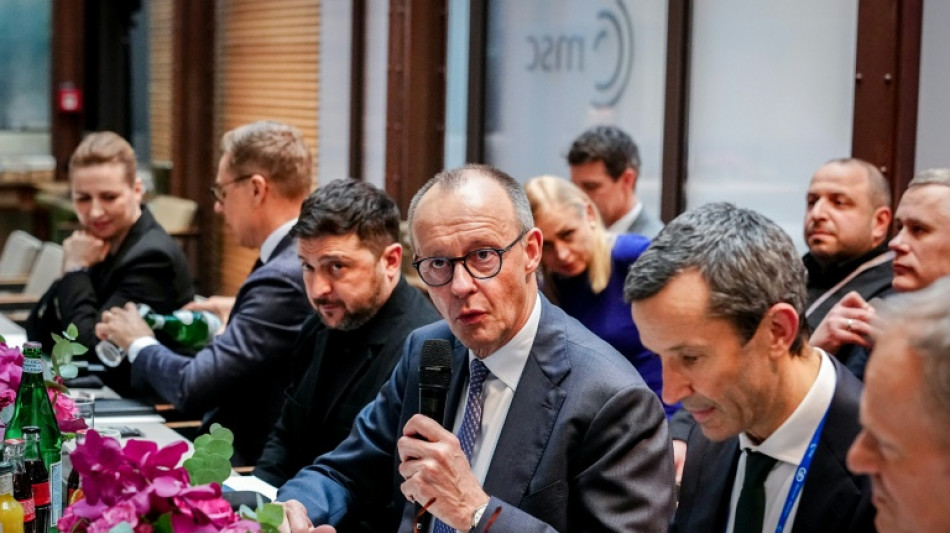
Europe calls for US reset at security talks / Photo: © POOL/AFP


German leader Friedrich Merz called Friday for "a new transatlantic partnership" between the United States and Europe, as he rallied officials at a top security conference under heavy pressure from US President Donald Trump.
European leaders were striving to shore up relations with Washington, insisting they were strengthening their defences in line with Trump's demands at what Merz and others described as a time of "upheaval".
This year's Munich Security Conference comes at a time of strained ties between Europe and the United States, after Trump threatened to take over Greenland and criticised "decaying" and "weak" European nations.
Russia's war against Ukraine, set to enter its fifth year this month, is high on the agenda, alongside efforts by European NATO members to raise their defence budgets out of concern that Moscow could seek to expand into their territory.
European leaders at the gathering defended their security commitments and the NATO alliance.
EU chief Ursula von der Leyen said on X that the bloc was "ready to take more responsibility for our own security" -- after Trump called it into question and accused allies of not spending enough on defence.
"Being a part of NATO is not only Europe's competitive advantage. It's also the United States' competitive advantage. So let's repair and revive transatlantic trust together," Merz said.
"In the era of great-power rivalry, even the United States will not be powerful enough to go it alone."
- US-Europe relations -
In his speech, French President Emmanuel Macron emphatically defended Europe, saying "everyone should take their cue from us, instead of criticising us".
US Secretary of State Marco Rubio, who arrived on Friday, is due to speak at the annual gathering on Saturday, as is Ukrainian President Volodymyr Zelensky, organisers said.
Rubio is seen as a more conciliatory choice of envoy, a year after US Vice President JD Vance used the same stage to attack European policies on immigration and free speech, shocking European allies.
A German government source said Merz and Rubio had met at the conference and discussed "Ukraine, the status of negotiations with Russia and further support for the country, particularly in terms of military aid".
They also discussed Iran and NATO, and "Rubio praised Germany's steps to strengthen the alliance," the source added.
Rubio also met his Chinese counterpart, Wang Yi, on the sidelines of the conference, an AFP journalist said, at a time of heightened Washington-Beijing tensions.
Rubio then held a 15-minute meeting with the prime ministers of Denmark and Greenland about the future sovereignty of the Arctic island. Denmark's Mette Frederiksen called the talks "constructive".
Ties plunged last month when Trump stepped up threats to annex Greenland, an autonomous territory of NATO ally Denmark, forcing European nations to stand firm in protest.
- Ukraine discussions -
Several top European leaders were scheduled to meet with Zelensky on Friday for talks on Ukraine, the French presidency said.
A US official said Rubio did not attend those talks due to a packed schedule, but was "engaging on Russia-Ukraine in many of his meetings" in Munich.
Ukraine's foreign minister Andriy Sybiga said he discussed ending the Russian invasion of Ukraine with Wang, whose country is a close partner of Moscow.
Wang told Sybiga Beijing was "willing to provide Ukraine with new humanitarian aid", according to a Chinese foreign ministry readout.
France's Macron, meanwhile, said a new framework was needed to deal with "an aggressive Russia" once the fighting in Ukraine ends, as Germany's spy chief warned of potential Russian interference in upcoming local elections.
Kremlin critic Mikhail Khodorkovsky said he feared "a new cold war" between Europe and Russia in the coming decade, making reopening dialogue with Moscow essential.
"If it makes sense to talk, we are willing to talk," said Merz. "But as you can see with the American side, Russia is not yet willing to talk seriously."
Zelensky, urged by Trump to "get moving" on a deal to end the war, visited a drone factory near Munich with German Defence Minister Boris Pistorius before meeting Merz and other European leaders.
"It's good to have strong partnership with Americans... but I think that Europe... needs (an) independent defence industry, very strong," he said.
"A strong Europe in a strong NATO means that the transatlantic bond will be stronger than ever," Rutte said.
W.Adams--VC