Iceland proposes August 29 referendum on resuming EU membership talks / Photo: © AFP




Iceland's government on Friday proposed that a referendum be held on August 29 on resuming the country's EU membership talks after they were terminated in 2015.
The North Atlantic island submitted an EU membership application in 2009, a year after the stunning collapse of its financial sector.
Negotiations began in 2010 but were suspended three years later following parliamentary elections, and in 2015 the then-government announced the talks were terminated.
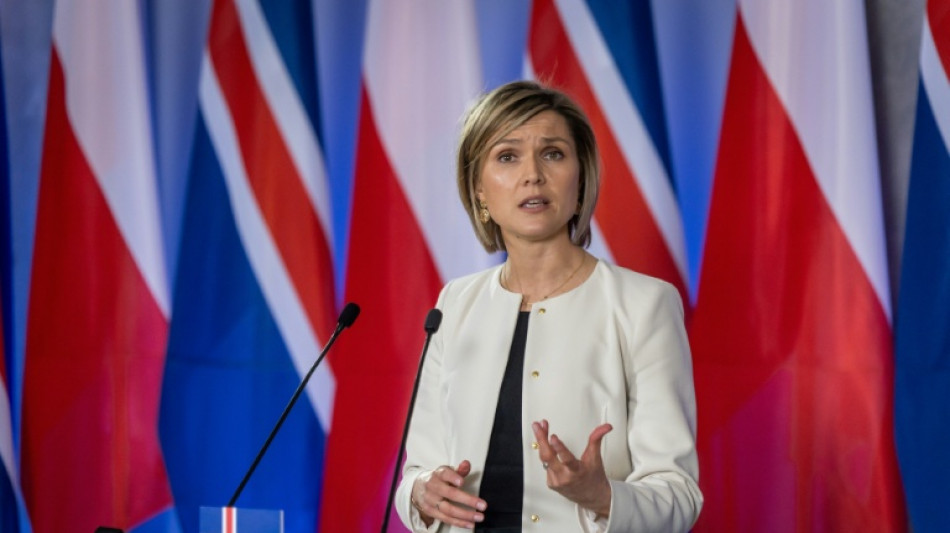
Foreign Minister Thorgerdur Katrin Gunnarsdottir told reporters she would present the proposal to parliament early next week. It remained unclear on Friday whether the government had a majority for its resolution.
"We intend to ask the nation the following question: 'Should negotiations on Iceland's accession to the European Union continue?' And then the nation can answer with two options: 'Yes, negotiations should continue', or 'No, they should not continue'," she said.
An opinion poll published in early February by public broadcaster RUV indicated that the Icelandic public was evenly divided on the question of EU membership.
The three parties of the centre-left coalition government had agreed in their government platform to hold a vote on the issue by the end of 2027.
Prime Minister Kristrun Frostadottir said the time was now right to put the question to the Icelandic people.
"Iceland is strong economically, but also in terms of national self-confidence, and thus able to make this decision," she said.
- 'World has changed' -
When Iceland's accession negotiations were paused, 27 of the 33 chapters had been opened, and 11 had been concluded, according to the government.
The chapter on fisheries, expected to be the thorniest as Iceland is intent on retaining control over its resources, had not been opened.
The foreign minister said that if negotiations were to resume, she didn't want to waste any time and wanted to go straight to the difficult chapters.
"I will never sign an agreement -- never sign an agreement -- that entails ceding Iceland's control over its resources, such as our fishing resources. I want that to be absolutely clear," she said.
Iceland's objectives with EU membership were "to ensure Icelandic control over our resources... to secure economic and social justice, to examine how we can strengthen our defences, not only stability but economic and other forms of security, in connection with being potential members of the European Union."
If given a mandate to resume talks, the completed chapters would be reviewed and updated in line with developments, she added.
Frostadottir also noted that the world had changed since Iceland last engaged in EU membership talks. The country would be "entering negotiations from a different position", she added.
"The emphasis on the North Atlantic and the Arctic, on cooperation among these countries, has been transformed," she said.
US President Donald Trump's desire to take over Greenland has sparked concern in neighbouring Iceland. Its defence is currently provided by the United States and NATO as it has no military of its own.
"All of us engaged in international cooperation can sense that awareness of Iceland's uniqueness, and of its strong position and interests... has changed dramatically," the prime minister said.
The European Union's enlargement chief Marta Kos on Friday said Iceland was set for a "significant decision" with its referendum.
"Iceland is already a strong and strategic partner," she said in a statement sent to AFP.
"In a world of competing spheres of influence, EU membership offers an anchor into a bloc grounded in values, prosperity and security."
The foreign minister expressed "serious concerns" that Russia might try to influence a future referendum.
"We are seeing very significant interference by Russia in states that are, among other things, leaning toward the European Union. This has been apparent for months," she said.
H.Gill--VC