Israel strikes Beirut suburbs as displacement shelters overflow / Photo: © AFP



Israel carried out new strikes on Beirut's southern suburbs and again ordered residents of vast parts of southern Lebanon to evacuate, as more than a million people have been displaced across the country.
Early Tuesday morning Israeli aircraft bombed two neighbourhoods of Beirut's southern suburbs, state media said, and also struck Doha Aramoun, south of the capital, wounding an Ethiopian woman.
Lebanon was drawn into the Middle East war on March 2 when pro-Iran Hezbollah launched rockets towards Israel in response to US-Israeli strikes that killed Iranian supreme leader Ayatollah Ali Khamenei.
Israel has responded with intense strikes in multiple Lebanese regions and some ground operations in the south.
Israel confirmed the Tuesday strikes, saying it was targeting Hezbollah, as it has since the start of the conflict, a day after announcing the start of "limited" ground operations in southern Lebanon.
Israeli strikes have killed 886 people, including 67 women and 111 children, since March 2, Lebanon's health ministry said on Monday, adding that 2,141 others have been wounded.
At the same time, the Israeli military renewed its call for residents to evacuate a region stretching more than 40 kilometres from the Lebanon-Israel border.
Around 14 percent of Lebanese territory is under Israeli evacuation warnings, according to the Norwegian Refugee Council.
Lebanese authorities said more than one million people had registered as displaced since March 2 -- more than a sixth of the country's population -- with more than 130,000 people staying in upwards of 600 official shelters.
These displaced people "will not return to their homes" in the south as long as the security of residents in northern Israel is not guaranteed, Israeli Defence Minister Israel Katz said this week.
- Overcrowded centres -
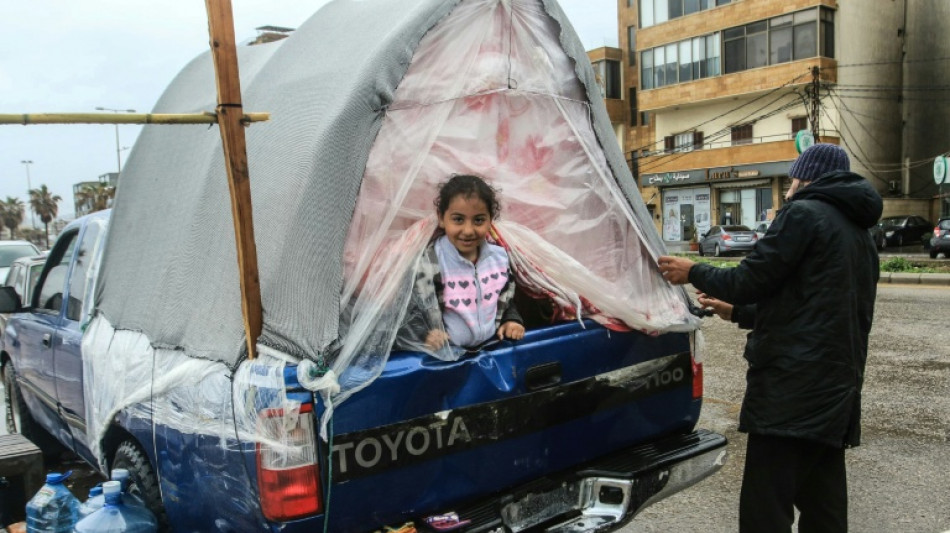
In the southern city of Sidon, far from the border, displaced people were sleeping in their cars parked along the seafront corniche, according to an AFP team on the ground.
"Saida is full, we have no more capacity", said Jihan Kaisi, the director of an NGO that runs a school-turned-shelter, where more than 1,100 people are crammed together.
"Lots of people are coming every day to ask for shelter but we don't have space anymore, we can't accept them," she added.
She said that the road from the south was blocked on Monday with people fleeing north following evacuation orders.
A strike on Tuesday morning targeted a building in a village in the Sidon region, after a warning from the Israeli military, according to state media.
Another strike in the Nabatieh region wounded five Lebanese army soldiers travelling in a car and on a motorcycle, one of them seriously, according to an army statement.
Alongside its massive bombardment campaign, Israel has announced that it is carrying out ground incursions in the south with troops and armoured vehicles.
On Tuesday the Israeli military said "additional... troops have been deployed in Lebanon, continuing efforts to establish a forward defence posture in order to remove threats and create an additional layer of security for residents of northern Israel against Hezbollah's threat".
Israel's military chief of staff Eyal Zamir said on Monday that "more than 400 terrorists have been eliminated so far".
Hezbollah said the same day that it had launched rockets and drones towards the city of Nahariya in northern Israel, where a man was wounded by an explosion, according to Israeli rescuers.
The group also claimed responsibility early on Tuesday for two rocket attacks on groups of Israeli soldiers near the villages of Maroun al-Ras and Meiss El Jabal, located on the border.
On Monday evening, the leaders of Germany, Canada, France, Italy and the United Kingdom warned that a large-scale Israeli ground operation in Lebanon "would have devastating humanitarian consequences and could lead to a protracted conflict".
F.Morgan--VC