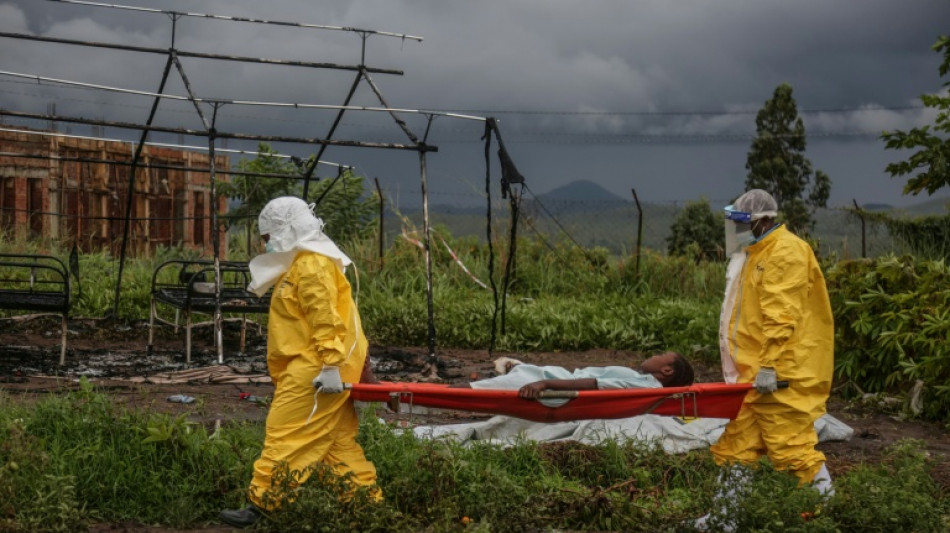
Uganda confirms new Ebola cases, linked to DR Congo / Photo: © AFP




Three new Ebola cases have been confirmed in Uganda, health authorities said Saturday, after the World Health Organization raised the risk from the deadly outbreak to the highest level for neighbouring Democratic Republic of Congo.
The new cases bring to five the total confirmed in Uganda since the current outbreak was discovered in the east African country on May 15.
It named the patients as a Ugandan driver, a Ugandan health worker and a woman from the DRC, the epicentre of the outbreak, which the WHO has declared an international emergency.
"Three new cases of the Ebola Virus Disease (EVD) have been confirmed in the country," the Ugandan health ministry said in a statement on X.
All three are alive.
On Friday, the WHO raised the risk from Ebola in the DRC to "very high".
The United Nations health agency said the regional risk in central Africa was "high", though it maintained the global risk was "low".
Ebola is a deadly viral disease that spreads through direct contact with bodily fluids. It can cause severe bleeding and organ failure.
There have been 82 confirmed cases and seven confirmed deaths in the DRC, alongside almost 750 suspected cases and 177 suspected deaths, the WHO said.
The outbreak, which experts suspect was circulating under the radar for some time, is caused by the less common Bundibugyo strain, for which there are no approved vaccines or treatments.
On Thursday, Uganda suspended all public transport to the DRC after confirming its first two cases -- one infection and one death -- involving Congolese nationals who crossed the border.
It said the driver confirmed infected on Saturday had been at the wheel of the vehicle in which one of the ill Congolese nationals had travelled to Uganda.
The health worker was exposed to the virus when she was treating that Congolese patient.
- 'Especially challenging' -
The third new case, the ministry said, was a Congolese woman who had been treated in Kampala for abdominal pains and discharged "in good condition" on May 14.
She tested positive for Ebola after she returned to the DRC.
"All contacts linked to the confirmed cases have since been identified and are being closely monitored," the health ministry said.
WHO director general Tedros Adhanom Ghebreyesus said on Friday the situation in the DRC was "especially challenging".
Health workers were scrambling -- in highly insecure, remote areas -- to catch up with the spread of the virus and track down contacts of everyone thought to be infected, he said.
The epicentre is in the eastern DRC -- neighbouring several African countries, including Uganda -- which has been plagued for three decades by conflict involving a litany of armed groups.
The DRC epidemic was first detected in Ituri province and has now spread to South Kivu, to an area controlled by the Rwanda-backed M23 militia.
State services in rural areas of Ituri have been largely absent for decades and its inhabitants are increasingly blaming the Congolese government for the slow response to the outbreak.
In South Kivu, M23 has never had to manage the response to a serious epidemic of a disease like Ebola, which has killed more than 15,000 people in Africa in the past half-century.
P.King--VC