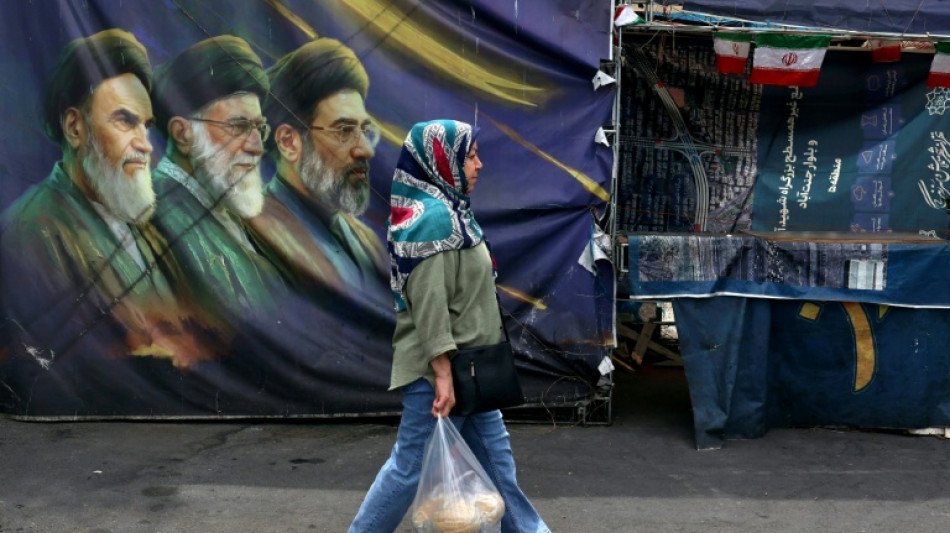
Iran says no trust in US 'words', waiting for Washington to act / Photo: © AFP



Iran's top negotiator said Friday that Tehran would only trust Washington's actions, not its words, after US Vice President JD Vance said progress had been made on a deal to extend a ceasefire and provide a framework for peace talks.
President Donald Trump has remained notably silent about the deal despite US sources telling AFP it only needed his sign-off, underscoring the unpredictability of talks three months after the conflict engulfed the Middle East and shook the global economy.
"We place no trust in guarantees or words; only actions matter. No step will be taken before the other side acts first," Iran's Mohammad Bagher Ghalibaf wrote on X.
The parliament speaker, who led Tehran's delegation at peace talks with the US in Pakistan last month, also warned that Iran had gained leverage not "through talks, but through missiles" fired at US bases and allies in the region when war broke out on February 28.
Hopes of an agreement had risen on Thursday after US officials were positive about the direction of diplomacy.
"It's hard to say exactly when or if the president is going to sign the MOU," Vance told reporters on Thursday. "We're going back and forth on a couple of language points. We've made a lot of progress here."
Optimism around a possible US-Iran deal boosted Asian stock markets on Friday, while oil prices receded slightly.
Energy markets have whipsawed this week as investors parse the chances of an agreement that could potentially resume normal shipping through the crucial Strait of Hormuz.
The potential deal would end restrictions on shipping through the strait, with no tolls or harassment, while Tehran would remove mines within 30 days and the US would lift its naval blockade of Iranian ports if commercial traffic resumed, according to US media reports.
But Iran has not confirmed any commitments to a deal, and sources have told Iranian media that any agreement unilaterally announced by Trump would not be recognised.
On Friday, Iran's Tasnim news agency, citing a source, said the text had not yet been finalised and that the wording of the potential memorandum of understanding had "undergone some changes in recent days".
- Truce violations -
The role of Qatar in talks has grown and its state news agency said late Thursday that Trump had called its ruler to discuss the "latest updates" on efforts to end the war.
Doha hosted Iranian officials this week as regional nations push for a definitive resolution to the US-Iran war, despite a fragile ceasefire largely holding since April 8.
Washington and Tehran have accused each other of violating the truce as recently as this week, with US strikes on the southern Iranian port of Bandar Abbas this week countered by retaliatory Iranian fire.
Iranian forces did not specify their exact target, but Kuwait, which hosts US troops, said its air defences responded to incoming Iranian missiles and drones.
Iran had also fired at four ships trying to transit the Strait of Hormuz without authorisation, state broadcaster IRIB reported Thursday. Iran has blockaded the waterway since the war began.
Iranian state TV said on Friday that 24 ships had transited the Strait of Hormuz in the last 24 hours, in coordination with the Revolutionary Guards and the Iranian foreign ministry.
But it warned that "ships from hostile countries face a severe response" from the Iranian military.
- Lebanon castle hit -
On the war's Lebanon front, the country's culture minister told AFP on Friday that Israel had struck a medieval castle that overlooks the southern city of Nabatieh, warning that other heritage sites were in "serious danger".
"Bombings fell very close to the ruins of Tyre," a UNESCO World Heritage site, Ghassan Salame said, adding that the medieval Beaufort castle in the Nabatieh area was "directly hit".
Israeli forces used the castle, also known as Qalaat al-Chakif, as a base during their previous two-decade occupation of southern Lebanon that ended in 2000.
A ceasefire between Israel and the Iran-backed Lebanese group Hezbollah was supposed to have taken effect on April 17, but has never been observed.
Both sides accuse each other of violating it and justify their attacks by the other camp's alleged breaches.
Lebanon was drawn into the Middle East war in early March when Hezbollah launched rockets at Israel over the killing of Iran's supreme leader in US-Israeli attacks, prompting Israeli strikes and a ground invasion.
On Thursday, Israel pounded south Lebanon with deadly strikes and widened its offensive with the first raid near Beirut in weeks, where authorities said a woman and two children were killed despite the truce.
burs-jfx/smw
E.Taylor--VC