Forced to eat grass, Oleshky evacuees say truce was a 'blessing' / Photo: © AFP



Evacuees from Oleshky, a bombed-out city in Russian-occupied Ukraine, told AFP that residents had to eat grass and dogs to survive and that their rescue following a humanitarian truce was a "blessing".
US First Lady Melania Trump announced the truce on October 23, saying the city was "on the brink of disaster".
Ukrainian and Russian officials visited the city together on Friday, delivering aid and evacuating those who wanted to leave in a rare show of cooperation between the warring sides.
Arriving in Ukraine on Saturday by bus, residents whom AFP interviewed painted a dire picture of life in the city.
"People were cooking grass," said Valera, a 29-year-old former resident who did not give his last name.
"They'd grow it, as there was nothing to eat."
He added that some residents were forced to shoot and cook dogs to survive.
"Lots of people were blown up. There were piles of bodies on the roads, loads of cars. In short, it was brutal... Terrifying," he said.
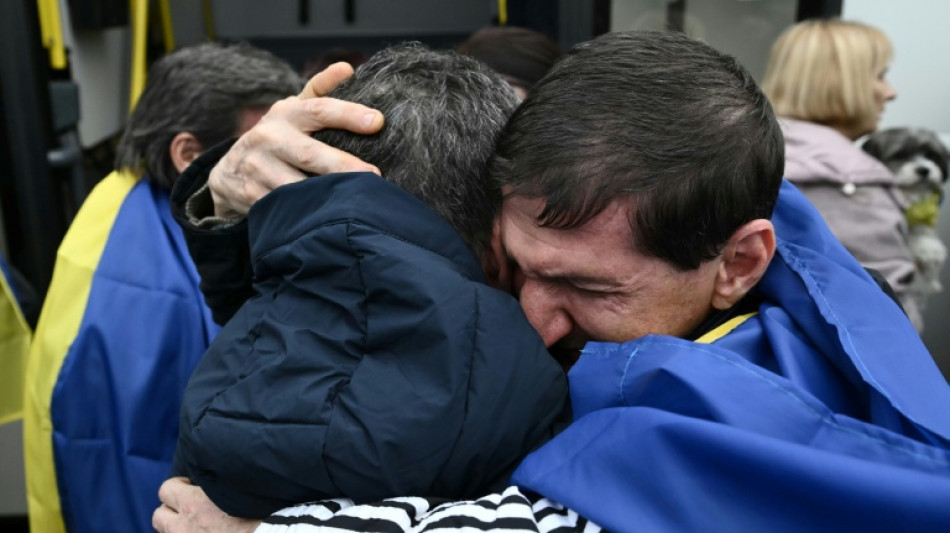
An AFP journalist saw the residents, some draped in Ukrainian flags, disembark from buses and tearfully embrace their loved ones.
The city in Ukraine's southern Kherson region was captured by the Russian military in 2022, and had been caught in intense fighting between the two sides that left residents starving and unable to escape.
- 'They got blown up' -
Yelyzaveta Paliy, who was waiting for her father to return, said she never expected him to be gone so long.
"We last saw him at the end of January 2024, when my sister, mum and I left, and he stayed behind," the 19-year-old said.
AFP saw Paliy, her mother and sister embracing Paliy's father in a circle.
"This is a blessing. I've been waiting a long time," her father said. "There's no life there anymore," he said of Oleshky.
Ivan, a 70-year-old resident, said life in Oleshky had been "really bad" over the past month.
"We've got a vegetable garden. We grew everything we needed there. Everything ourselves, so we managed more or less. We shared with the neighbours," he said.
"We had these specialist lads who cleared the mines themselves and set off. They drove in their cars, and they got blown up," he said.
He said one of his relatives had lost four vehicles driving out of Oleshky.
"What else could we do? Starve to death?"
Around 2,000 residents -- compared with 24,000 before Russia's 2022 invasion -- were still in Oleshky ahead of the humanitarian operation, according to Kyiv's estimates.
Neither Moscow nor Kyiv has specified the number of people evacuated, and authorities in both countries previously indicated that many residents wished to remain in the city, even in the event of renewed fighting.
U.Hernandez--VC