Colombia's Foreign Minister Omar Bula Apologizes to US Democrats for Past Social Media Remarks


Colombian Foreign Minister Omar Bula has publicly apologized to members of the United States Democratic Party for offensive comments he previously made on social media. The diplomatic move aims to separate the current Colombian government’s foreign policy from Bula’s past political rhetoric, particularly following significant Democratic victories in the recent US midterm elections.
Colombian Foreign Minister Omar Bula has issued a public apology to members of the United States Democratic Party over a series of offensive comments he previously made on social media, in a diplomatic effort to distance the government of President Abelardo de la Espriella from his past political rhetoric.
In a letter dated November 10 and made public on Wednesday, November 11, Bula acknowledged that his earlier remarks about Democratic leaders, including Kamala Harris, Barack Obama, and Hillary Clinton, had been inappropriate and disrespectful. The apology comes just days after Democrats secured a sweeping victory in the November 3 US midterm elections, winning control of both chambers of Congress and several governorships.
“I want to offer my sincere apologies for comments I made in past social media posts about leaders of the Democratic Party. The language I used was inappropriate and disrespectful, and I regret the words and the offence they caused,” Bula wrote.
The foreign minister was responding to renewed scrutiny of posts published before his appointment to Colombia’s diplomatic service. Bula sought to make clear that his previous statements belonged to a different political moment and should not be interpreted as an indication of the current administration’s diplomatic priorities.
“Those posts were written long before I became Minister of Foreign Affairs, in the context of a particular presidential election. While that context helps explain the circumstances in which they were made, it does not diminish my responsibility for what I wrote,” he acknowledged.
“My perspective has evolved since then, and those messages do not reflect the views I hold today. Nor do they in any way represent the position of the Government of Colombia under President Abelardo de la Espriella.”
The timing of the apology is politically significant. The Democratic victory in the midterms has transformed the balance of power in Washington, ending unified Republican control of Congress and placing the party in a position to exercise considerably greater influence over legislation, government spending, and congressional oversight.
For Colombia, the implications extend well beyond the domestic politics of the United States. Washington remains one of Bogotá’s most important strategic partners, with bilateral cooperation spanning security, intelligence sharing, counternarcotics operations, trade, investment, and regional stability.
The relationship has historically enjoyed bipartisan support in the United States, surviving changes of government in both countries. From the implementation of Plan Colombia to subsequent security and economic cooperation agreements, successive Democratic and Republican administrations have recognized the importance of maintaining a close relationship with Bogotá.
That institutional continuity is particularly important for a Colombian government seeking to consolidate its relationship with Washington. While President De la Espriella has aligned his administration with Donald Trump’s Republican leadership on security and regional policy, the Democrats’ congressional gains mean that Colombia cannot afford to approach its relationship with the United States exclusively through a Republican political lens.
Congress has an important role in determining foreign assistance, approving budgets, and overseeing international security programmes. Consequently, maintaining constructive relations with Democratic lawmakers will be essential to safeguarding the continuity of programmes that have underpinned bilateral cooperation for decades.
Bula’s letter appears designed to address precisely the current realpolitik.
Since taking office, the Foreign Minister says he has advocated a bipartisan approach to Colombia’s relationship with the United States. He also emphasized that the country’s interests must take precedence over individual political affiliations.
“As Minister of Foreign Affairs, I have a responsibility to represent Colombia with respect, openness and a commitment to constructive dialogue,” he wrote, adding that this responsibility requires listening to different perspectives and advancing the shared interests of both countries.
The message was also intended to demonstrate that Bogotá recognizes the importance of maintaining relationships across the American political spectrum, regardless of electoral cycles or differences between the two parties.
Bula’s apology follows criticism from Democratic lawmakers, including Representative Gregory Meeks, who raised concerns about the minister’s previous statements and called on the De la Espriella administration to address the issue.
The diplomatic challenge is therefore not simply one of managing an uncomfortable social media history. It is about establishing the credibility of Colombia’s foreign policy at a moment when the political landscape in Washington has shifted considerably.
For a country whose security and economic interests remain closely connected to the United States, the ability to work with both Republicans and Democrats is a strategic necessity rather than a diplomatic courtesy.
Bula has acknowledged that his impetuous language was inappropriate. Whether his apology is sufficient to restore confidence among Democratic lawmakers remains to be seen. But his message is clear: the foreign policy of Colombia must be measured by the interests and priorities of the country, not by the political opinions its foreign minister expressed before assuming office.
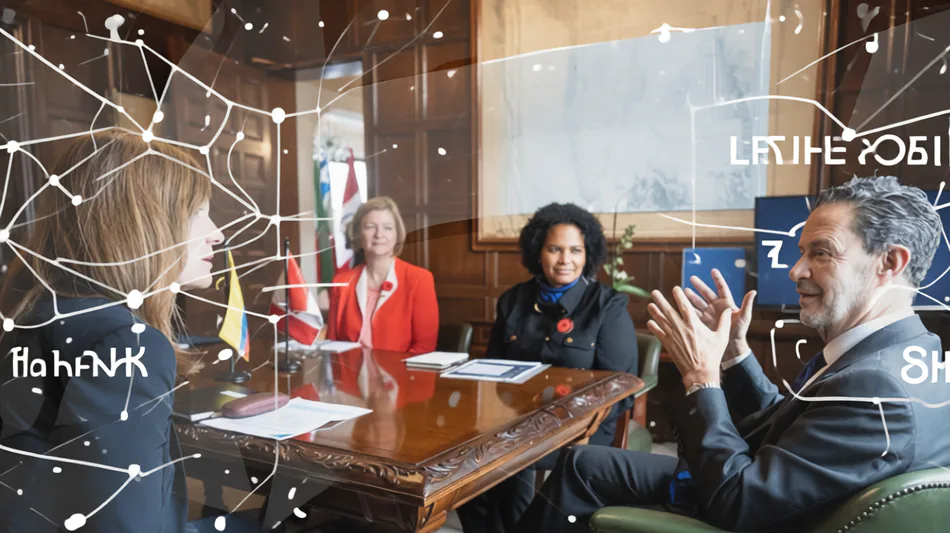
The diplomatic outreach was also reflected in Bogotá’s relationship with another longstanding North American partner. On November 11, Bula met with Canada’s Vice Minister of International Development, Cynthia Termorshuizen, to reaffirm more than seven decades of diplomatic relations between the two countries and explore opportunities to deepen their strategic partnership.
The discussions focused on expanding cooperation in agriculture, strengthening micro, small and medium-sized businesses, supporting rural entrepreneurship and training, and promoting development projects led by women. Both delegations also identified opportunities for investment in clean energy, agro-industry, infrastructure, and responsible mining, with an emphasis on sustainable economic growth and regional development.
Colombia’s Foreign Ministry said the objective was to continue consolidating the country as a key Canadian partner in Latin America, generating opportunities and well-being across both nations.
Taken together, Bula’s diplomatic engagements underline the importance of a foreign policy built around institutional relationships and economic cooperation. Whether dealing with Republicans and Democrats in Washington or strengthening longstanding partnerships with Ottawa, Colombia’s interests ultimately depend on its ability to maintain constructive relations across political divides.
D.Ward--VC