A nation divided over Team Melli as Iran faces Belgium / Photo: © AFP




Hundreds of football fans gathered beneath the towering bookshelves of Tehran Book Garden on Sunday night to watch Iran take on Belgium in the World Cup.
Unlike many national teams whose supporters rally unquestioningly behind them however, Team Melli arrived at kickoff carrying the weight of deep divisions at home.
Inside the sprawling cultural complex, families, students, pensioners and young couples filled rows of seats facing giant screens broadcasting the match from the United States.
Some wore Iranian flags around their shoulders while a number of kids had the colours of the flag painted on their faces.
As the players emerged from the tunnel, applause rippled through the hall but not everyone joined in.
"Because I was playing football from a very young age myself and I love football, I love all the matches and watch them all," Farhad Cheshmi, 29, told AFP at the Tehran Book Garden, noting that he didn't care much about this particular game.
The mixed feelings reflect broader debates that have surrounded Iran's national side in recent years.
Some critics view the team as too closely associated with state institutions and remain angry over political developments at home.
Others argue that poor management has weakened Iranian football, pointing to the appointment of officials with political or military backgrounds to senior sporting positions.
Many fans have also questioned technical decisions, including the absence of star striker Sardar Azmoun, one of the country's most recognisable footballers.
- 'Disappointed' -
"It is true that the team has been involved in many controversies but no matter what, it is the national team of our country," said Amir Hossein Rahimi, 25, who works in the private sector.
He was however "disappointed with a number of issues" including the failure to include Sardar Azmoun in the team.
Such complaints have become commonplace on social media and sports talk shows.
Yet the criticism has not erased support completely.
Many Iranians distinguish between their frustrations with football administrators and their feelings toward the players wearing the national jersey.
For them, backing Team Melli remains an act of patriotism rather than an endorsement of those running the sport.
"We are Iranians and we support our team no matter what; We really like to see it win," Said Roza Assari, 36, who works at a pharmaceutical company, told AFP.
"I think sports should not be mixed up with politics; any country has its own national team and that team trying to get a good standing for that country," she added.
- Restrictions on supporters -
The debate has intensified because of the unusual circumstances surrounding Iran's World Cup campaign.
Relations between Tehran and Washington remain deeply strained, and many Iranian supporters were unable to travel to the United States to attend matches.
As a result, fans have been watching from afar while stadium seats that might otherwise have been filled by Iranian supporters remain largely occupied by neutrals -- or members of the diaspora already living abroad, who are mostly critical of Team Melli.
Several spectators said the restrictions had made them more sympathetic toward the team.
"Many of our spectators were not allowed to go and watch the games," said Amir Hossein Rahimi, adding that it must be difficult playing without your supporters. While other teams have thousands of fans behind them.
Others pointed to logistical challenges facing the squad.
- 'Unequal' treatment -
With its World Cup base located in Tijuana, Mexico, Iran has faced repeated long-distance travels before and after matches in the United States.
Iranian football officials have publicly complained about the arrangements, arguing that the schedule places additional strain on players compared with some rival teams.
"For this big game, it affects the team's situation, and well, the situation is unequal, and this is American politics, and there's nothing you can do about it," said Farhad Cheshmi.
The debate unfolded against the backdrop of Muharram, the sacred month of mourning observed by Shia Muslims.
Outside Book Garden, black banners hung across nearby streets and buildings, and the distant rhythmic beat of drums and religious chants could occasionally be heard.
Inside, however, attention remained fixed on football.
For many spectators, the coexistence of mourning ceremonies and World Cup excitement reflected the complexities of modern Iranian life.
A week earlier, Iran had opened its campaign with an entertaining 2-2 draw against New Zealand, a result that left qualification hopes alive but increased the importance of the Belgium match.
As kickoff approached, disagreements over coaches, administrators, politics and player selections gradually faded.
For ninety minutes at least, supporters and critics found themselves watching the same screen, celebrating the same attacks and groaning at the same missed opportunities.
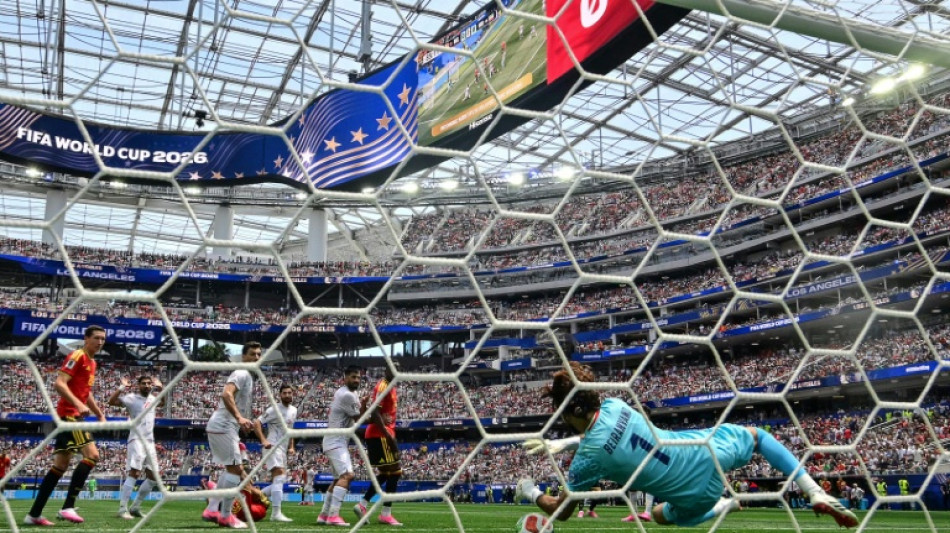
In the end, Iran's keeper Alireza Beiranvand kept them in the game with a series of saves, and with the match ending 0-0 the team still has a chance of reaching the next round of the tournament.
L.Martin--VC