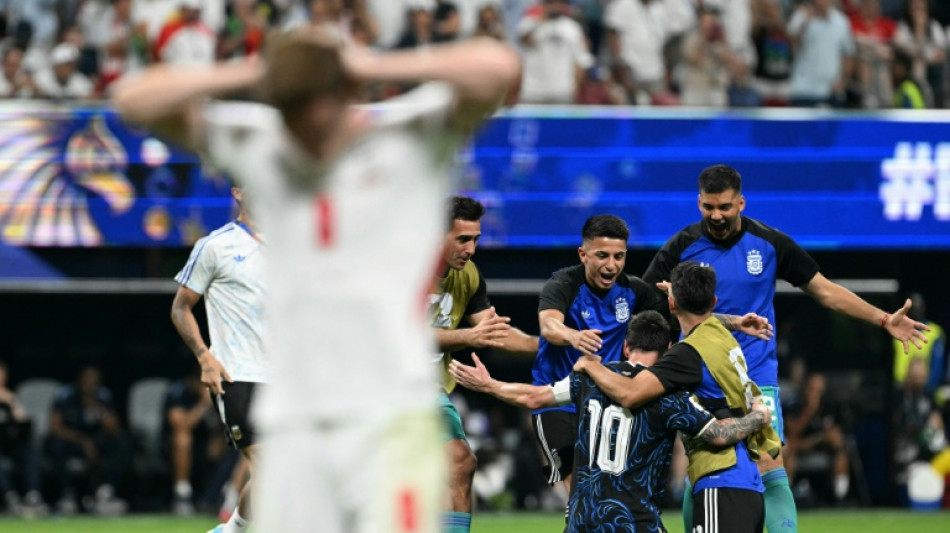
What's behind the Argentina World Cup team's can-do attitude? / Photo: © AFP




Argentine football players know how to suffer, experts and fans believe, as the South American nation sets its sights on a second consecutive World Cup title.
This has been the common refrain among the players, their coaches and their fervent fans before Argentina face Spain in the final in New Jersey on Sunday.
"I think this team plays its best when it's in trouble," said coach Lionel Scaloni on Wednesday, after the team conceded the first goal to England in the semi-final but hit back for a stunning 2-1 victory.
The 2026 edition of the World Cup has seen Argentina turn it around late in games time and time again in the knockout stages, normally thanks to their undisputed leader Lionel Messi.
First, they had to score twice in extra-time to beat underdogs Cape Verde 3-2 just to reach the last 16.
Then trailed Egypt 2-0 with just over 20 minutes remaining, before Messi inspired them to three late goals.
In the quarter-finals, Argentina looked tired but narrowly avoided a penalty shootout against Switzerland by scoring twice in the second period of extra-time.
"It's a group of people who, despite adversity, never give up," Matias Cirelli, a 44-year-old lawyer and keen fan from Buenos Aires, told AFP on Thursday, his voice hoarse from raucous celebrations the day before.
Cirelli links the team's resilience to the "many hardships" he believes Argentina has endured over the years.
"Argentines are never going to consider a battle lost, even if the outlook is completely unfavorable," he said.
- 'Success-driven country' -
Many believe that Scaloni's leadership has fostered this can-do attitude.
Since landing the role in 2018, he has focused on building a strong circle around eight-time Ballon d'Or winner Messi, now aged 39.
Messi, considered by many the greatest player in the sport's history although he faces competition from not least Diego Maradona, found World Cup success at a relatively late stage of his career.
Scaloni and Messi have turned Argentina into a winning machine over the subsequent eight years, claiming back-to-back Copa Americas either side of the country's third World Cup title in Qatar in 2022.
Pablo Nigro, president of the Argentine Sport Psychology Association, praised this "very long work process."
"This team sees pressure as an opportunity for self-improvement, for excellence," he told AFP.
Nigro believes that such a disposition is partly innate, and partly a product of "the high level of demand that exists in Argentine football and in Argentine society."
"We live in a very success-driven country, where from a young age we're constantly expected to win," the psychologist said.
- 'Head held high' -
Argentine youth development shapes the personalities of those who make it to the national team, said anthropologist Federico Czesli, whose research at San Martin University focuses on professional soccer training.
Youth development programmes preach the values of sacrifice and humility, Czesli said, with many children coming from low-income households.
From a very young age, players feel that repaying their families and their coach is non-negotiable.
"What humility does is give the player... the main tool for overcoming adversity and moving forward," he said.
The fervour of the fans who have routinely outnumbered opposition supporters at Argentina's World Cup games also creates a "ban on easing up", the academic said.
The typical fan "demands from the Argentine footballer not so much good play as giving everything," Czesli said. "As long as that happens, you leave with your head held high."
I.Kaur--VC