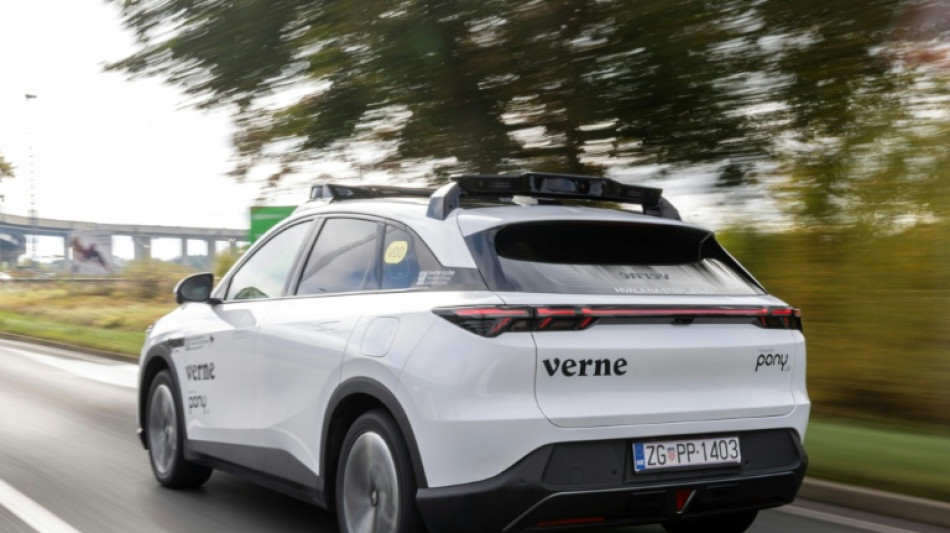
Croatia trials full driverless robotaxi service / Photo: © AFP



A Croatian firm that launched Europe's first commercial robotaxi service earlier this year is now testing fully driverless rides in the capital, its chief executive told AFP Tuesday.
Since April, Verne -- which is backed by Uber and powered by Chinese self-driving firm Pony.ai -- has been operating a commercial robotaxi service in Zagreb.
So far a backup driver, or so-called safety operator, has remained in the driver's seat during the rides.
But on Tuesday, Verne invited an AFP journalist to ride along on what its CEO Marko Pejkovic described as Europe's "first" fully automated robotaxi rides, which he hopes to roll out commercially next year.
"Now we are beginning to test a fully driverless robotaxi service, with no operator in the vehicle anymore."
"This is the first one in Europe."
Autonomous taxis are already operating in the United States and China.
Last month, London became the second European city, after Zagreb, to roll out a service that keeps a safety driver in the vehicle.
At the same time, other companies are competing to launch the continent's first fully automated robotaxi services.
- 'Very relaxed' -
Pejkovic said his company began testing fully autonomous rides in August on its 22-kilometre (14-mile) route between its Zagreb headquarters and the capital's airport.
He expected the service to become available to the public next year and eventually roll out in other European cities.
Verne's fleet of around 30 automated vehicles operates in the city centre, around the airport, and in selected nearby areas.
According to the company, around 1,500 people use it in Zagreb, with more than 10,000 on the waiting list.
Users can order the service through Verne's or Uber's app, and the company has kept the price of rides locked at 1.99 euros ($2.22) to attract users and encourage feedback.
With thousands of commercial rides, Pejkovic said the average rating is 4.8 out of five, stressing that users find the autonomous vehicles "very comfortable and very safe".
During AFP's ride on Tuesday, the trip was smooth and issue-free.
The front passenger seat was removed and replaced with a large screen where you could monitor the route, use various apps, watch videos, or play games.
"Passengers feel very relaxed," Pejkovic said, adding that some feedback suggests people even feel a bit bored -- something he was happy with.
"When you feel safe, you feel that it's something very regular, even a little bit boring."
O.Kelly--VC